Oilfy is now a live venture that digitalizes Saudi Arabia's used cooking oil (UCO) supply chain, and Opexil Consultancy & Services (OCS) built it as its technology partner. Through our Startup Venture Stream, we took Oilfy from idea to MVP, to market, to live operations.
This post covers what we built, how we kept it lean on cost and time, how it runs on Google Cloud, how we automated invoicing with Odoo and ZATCA compliance, and where we are taking it next with AI.
The problem: oil poured away, deals on paper
Every day, restaurants produce used cooking oil, and too much of it is poured away or sold with no record. Restaurants rarely knew whether they were getting a fair price. Recycling companies juggled pickups by phone, and nobody could prove that the litres collected matched the litres in the drum.
Oilfy set out to fix that with one simple promise to restaurants: free to join, no commitment, paid for every litre. Our job was to build the technology that makes that promise trustworthy.
What we built: one engine, four products
We built Oilfy as one smart system on operational data, serving three parties: restaurants, recycling companies and the Oilfy team. Every product feeds the same engine, so each step of weigh, collect, document and pay leaves a record.
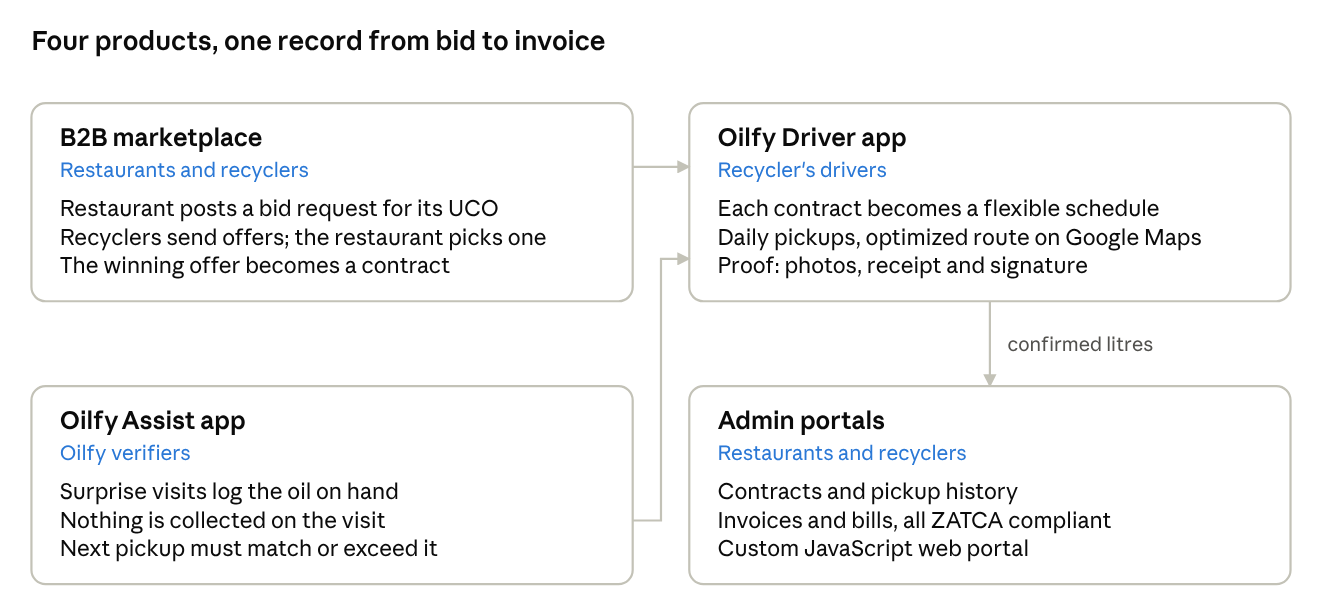
On top of the engine sit the views each party needs: a Daily Pulse for management, a page per restaurant with its own data, and dispatch lists that send the right truck at the right time.
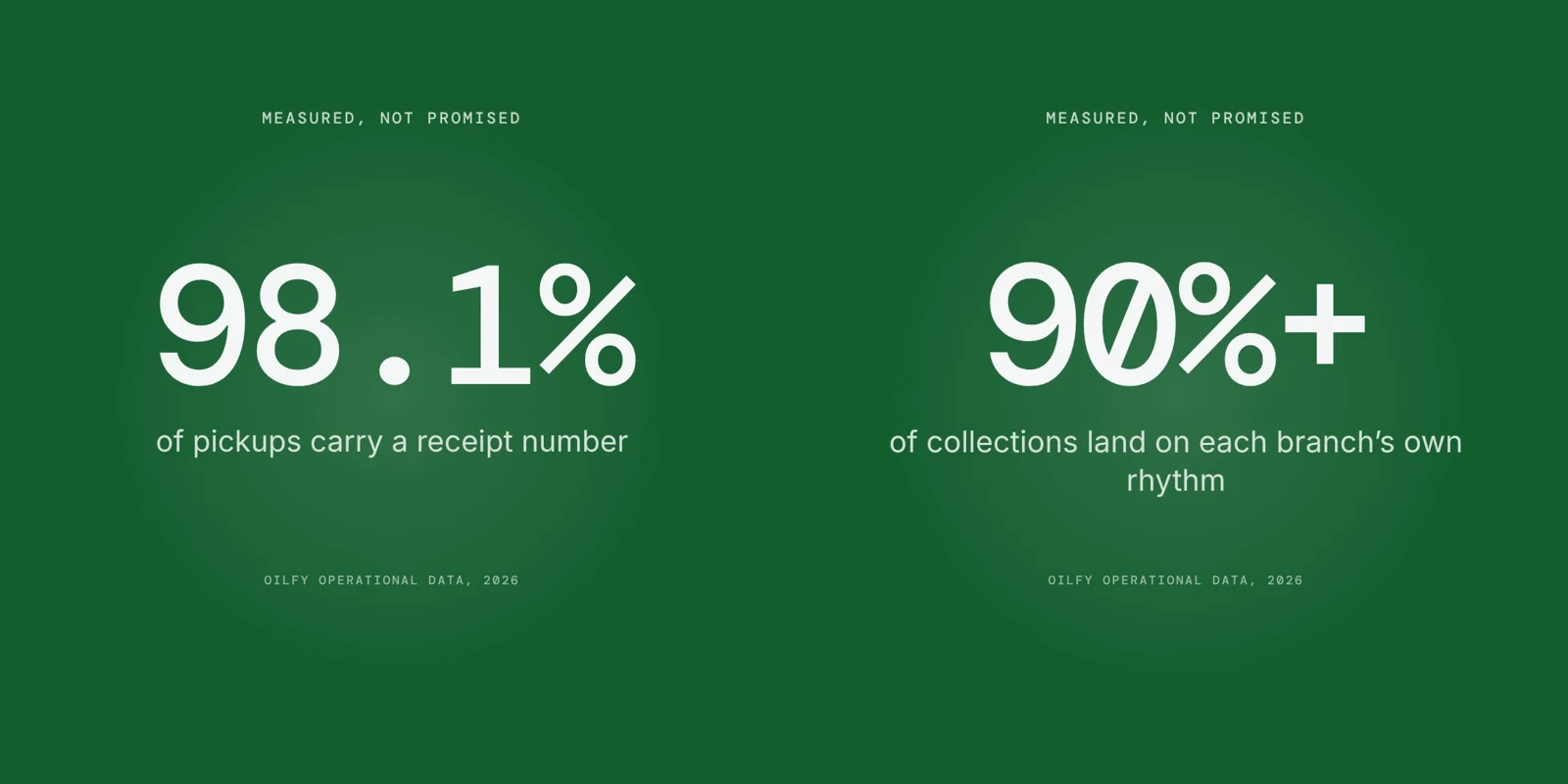
The results are measured, not promised:
World-class capability at startup cost and speed
We delivered enterprise-grade capability on a startup budget by building only what made Oilfy different and adopting proven platforms for everything else. We started in November 2025 and Oilfy went live in April 2026.
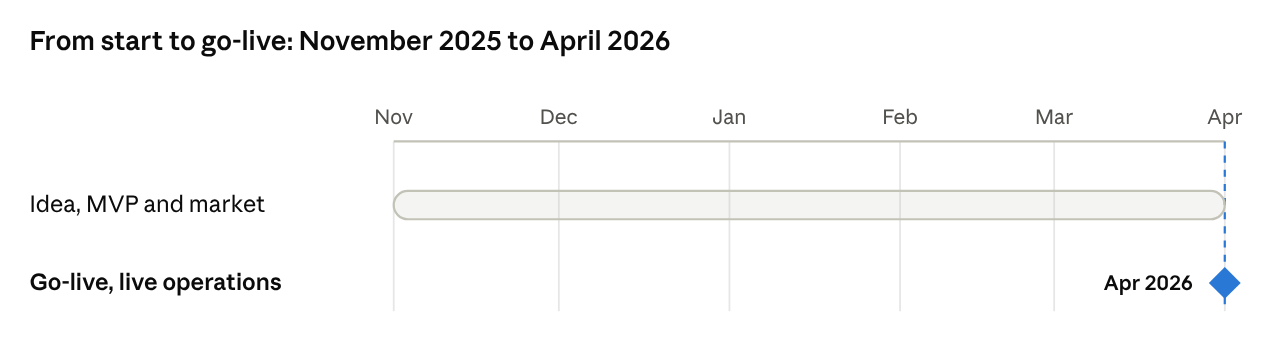
Our Startup Venture Stream moved Oilfy through four steps, each one shipping something real:
- Idea. We mapped the UCO chain with Oilfy's founders: who sells, who collects, and where trust breaks down.
- MVP. We launched the core loop first: marketplace, contract, pickup with proof.
- Market. We added verification, portals and invoicing as real restaurants and recyclers came on board.
- Live operations. Oilfy now runs daily on the platform, and its data drives every improvement.
Three choices kept cost and time down:
- Managed cloud over servers. Google Cloud's pay-as-you-go services meant no hardware to buy and capacity that grows with demand.
- Custom where it matters, platforms elsewhere. We custom-built what makes Oilfy unique, a JavaScript-based web portal and three mobile apps, and used proven platforms for the rest: Odoo as the back-end ERP, the Google Maps API for navigation and route optimization, and Data Studio for analytics.
- One data engine. Every app writes to the same model, so a new report, portal or feature reuses data that already exists.
Our technology stack at a glance:
| Layer | Technology |
|---|---|
| Web portals | Custom JavaScript-based stack |
| Mobile | Three mobile apps, including Oilfy Driver and Oilfy Assist |
| Back-end ERP | Odoo, with ZATCA-compliant e-invoicing |
| Maps and routing | Google Maps API for navigation and route optimization |
| Analytics | GCP Data Studio (now Looker Studio) |
| Hosting | Google Cloud Platform |
Scaling on Google Cloud, with data everyone can see
Oilfy runs on Google Cloud Platform (GCP), so it scales with each new restaurant, truck and city without re-engineering. Managed services handle availability, security and backups, and Oilfy pays only for what it uses.
For reporting we used Google's Data Studio, now called Looker Studio. It connects straight to Oilfy's data, at no licence cost, and powers the Daily Pulse for management and the dispatch lists for operations, with no one building spreadsheets by hand.
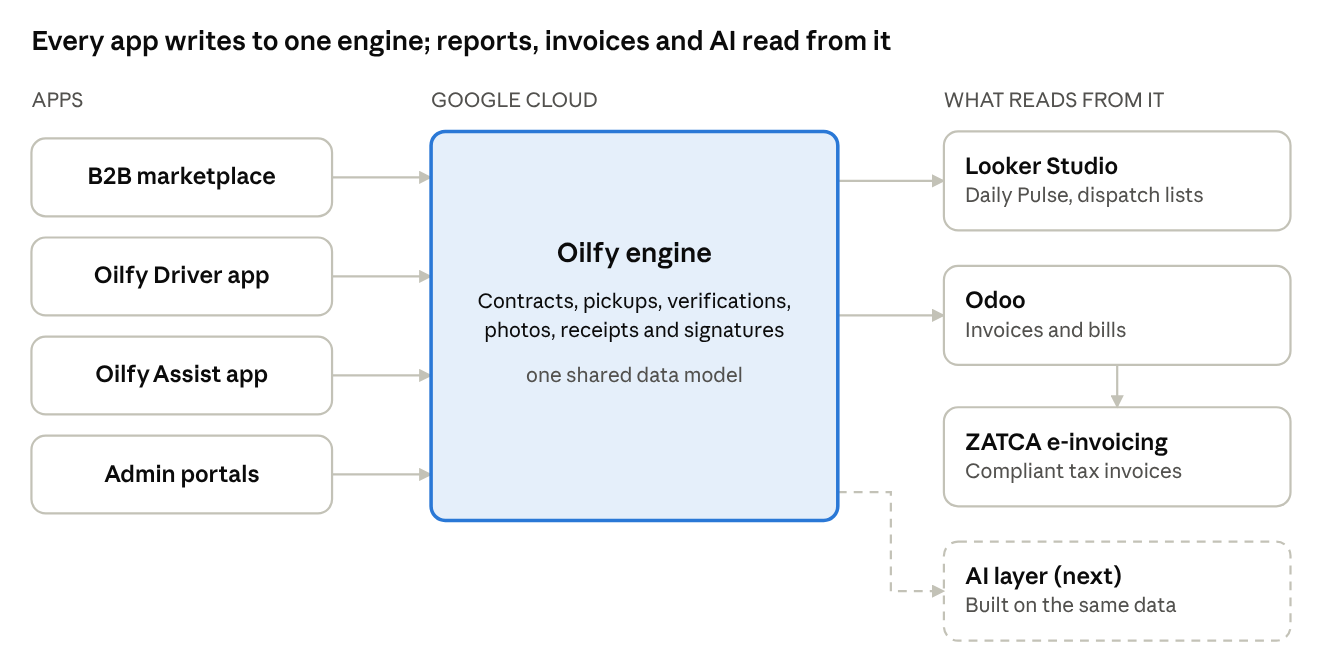
Every app writes to the same engine, and every output reads from it: dashboards, invoices and, next, AI.
Automating the back office: Odoo and ZATCA compliance
We automated Oilfy's invoicing end to end, so a confirmed pickup becomes a compliant invoice with no manual data entry. Rather than build accounting from scratch, we implemented Odoo and connected it to the Oilfy engine.

Every invoice and bill is issued to meet ZATCA's e-invoicing (FATOORA) requirements. The result is fewer manual steps, fewer errors, and records that hold up to an audit. Because the invoice is built from the same pickup record the driver signed, the litres billed are the litres collected.
What's next: AI on top of Oilfy's data
Oilfy is now scaling to use AI, and its clean, connected data is what makes that possible. Every pickup, verification and invoice already sits in one engine on Google Cloud, so AI can work on trusted records from day one.
The areas we are exploring:
- Forecasting. Predict each branch's oil volume so pickups are scheduled before drums overflow.
- Smarter routes. Feed forecast volumes into the Google Maps route optimization drivers already use.
- Fraud signals. Flag pickups that fall short of a verifier's reading, or that break a branch's usual pattern.
- Document reading. Read receipt photos automatically and match them to the pickup record.
From idea to a live venture
Oilfy shows what our Startup Venture Stream delivers: a real business, live in the market, built on world-class technology at startup cost and speed. We brought the product thinking, the cloud architecture, the apps and the back-office automation, and we keep building with Oilfy as it grows.
Have an idea that needs a technology partner to take it live? Talk to us, and see Oilfy at oilfyapp.com.